
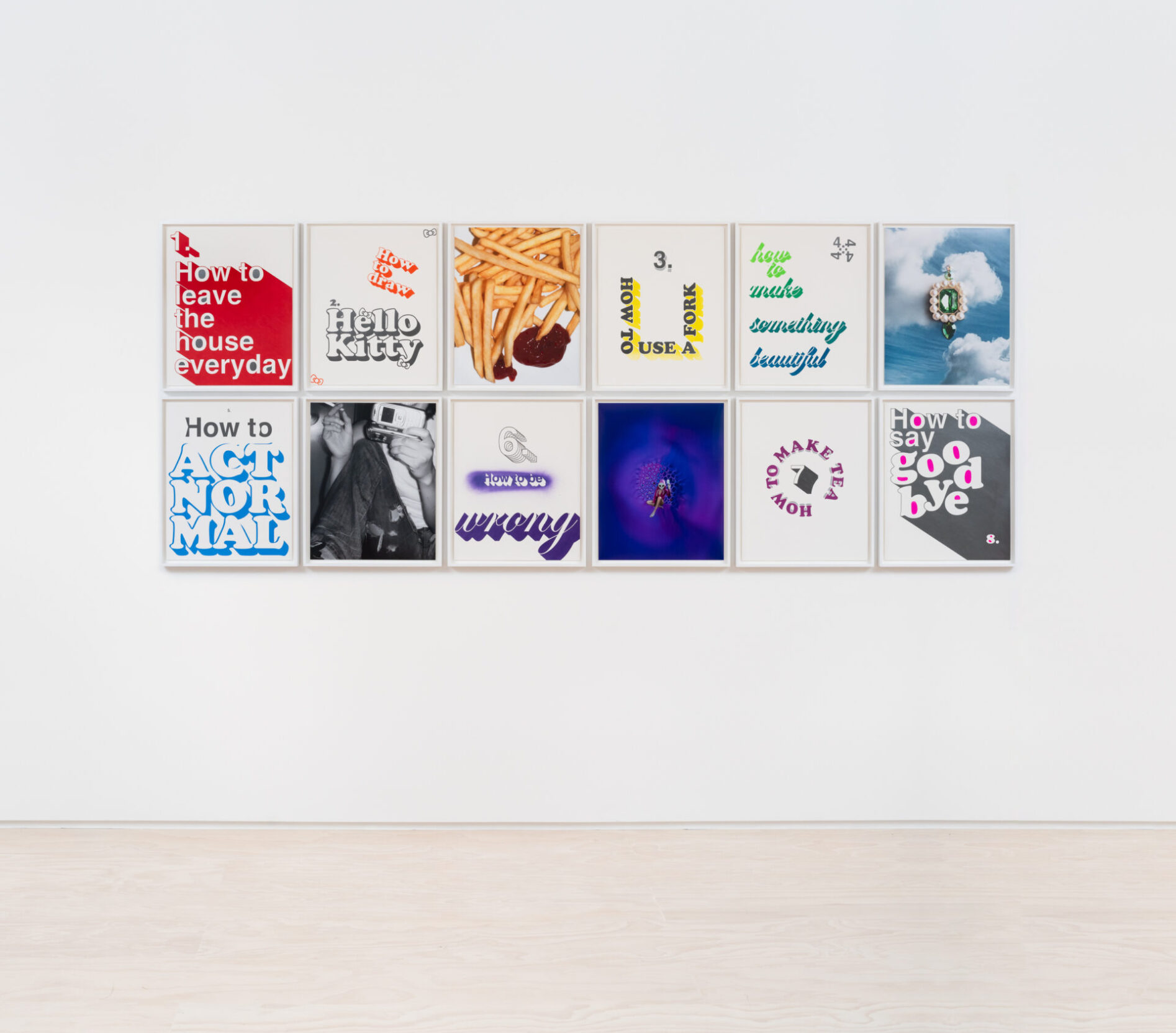
The Polyptychs are a manual of unasked questions. How to win. How to lose. How to act normal. How to get free. Each phrase is both an interrogation and a declaration of how to live in a world that doesn’t offer any clear answers. Instead, photographs adorned with glimmering crystals act as snapshots of the beauty found in everyday life. Collages formed from photographs of constructed objects are scanned, printed, arranged, layered and scanned again. Drawings are rendered so meticulously that they no longer look hand-made but instead resemble mechanically produced prints. Paintings made with spray paint eschew gestural marks in favor of rigidity and control. The Polyptychs gather these multifarious mediums – photography, drawing, painting and collage – only to turn them on their heads. These works investigate how we might navigate the problems, contradictions and outrageous beauty of our lives by refashioning the tools at our disposal.
Grids of identical white frames act as both containers and unifying structures which hold dissimilar imagery together. Meticulously structured drawings nestle up against ephemeral photographs of pleasure and play. Reminiscent of pages in a book or a series of posts in a digital feed, the Polyptychs may invite a linear or sequential reading from one frame to the next.
Yet, colors, shapes and patterns resonate across frames such that the eye might also move diagonally, sequentially, scatter in any number of directions, or take in the whole composition at once. In this order of juxtaposition, the Polyptychs invite an improvisatory gaze. The system creates room for both pattern and abstraction
While the aesthetic is characteristically minimal, this way of working is also about a kind of maximalism. It’s about using anything and everything to get closer to a texture, an experience, a condition of being, and visualizing the correspondence between individual and collective. It’s about resisting the demand to condense oneself into a singular form. There is so much order and restraint in the work, but there is also a chaos, a hyperactive layering, sampling, an exponential “one more thing!”. Each work is an accumulation of processes and references – some public, some private, always intimate. One gets the sense that these images could go on forever, and that each Polyptych might just be one small unit of a larger and ever expanding grid.
— Sadie Barnette, April 2025